
Resource Library
Work-Zone Safety Is a Temporary Location Problem
By Simon Maselli
- temporary traffic management
- roadworks
- work-zone safety
- Safe System
- local roads
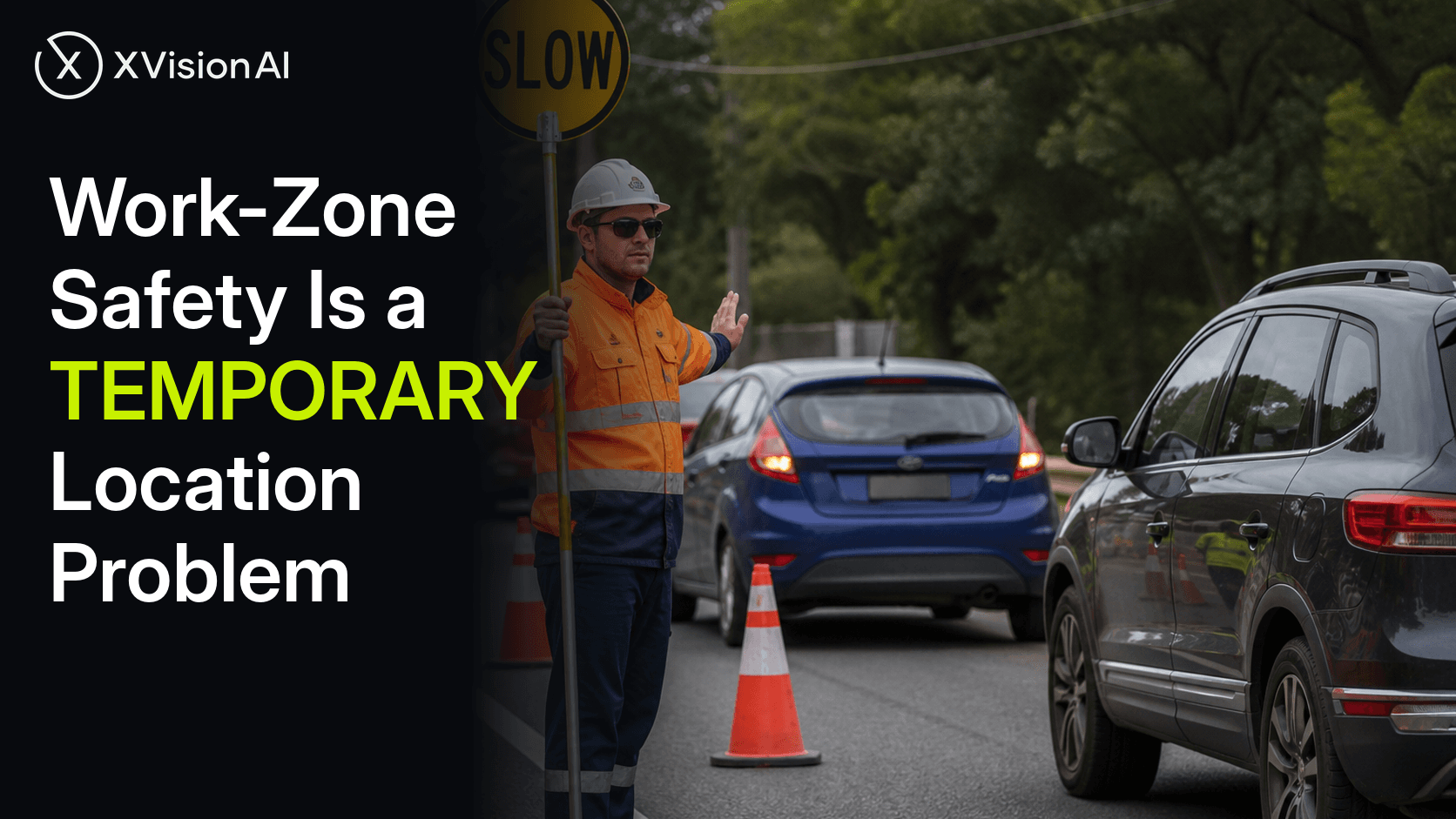
Australia is rewriting the rulebook for temporary traffic management. Austroads has released Edition 2.0 of Guide to Temporary Traffic Management Part 8, locking in a national training framework. Main Roads Western Australia has updated its Traffic Management for Works on Roads Code of Practice through 2025 and into a March 2026 edition. Transport for NSW and iMOVE have finished field trials of end-of-queue treatments across 13 NSW roadworks zones. Austroads data still show an average of 18 fatal worksite crashes and 245 serious-injury crashes a year, with near-misses heavily under-reported. The gap is not another template. It is the ability to treat each work zone as a location — to ask what is happening here, decide what to do, see what changed after the Traffic Guidance Scheme went in, and compare it with the rest of the temporary network.
The TTM wave is real. The location clock is not.
In February 2025 Austroads published AGTTM Part 8 Edition 2.0 — Temporary Traffic Management Categories and the National Training Framework. The National Training Framework has been operational since January 2024 and is already live in South Australia, Victoria, the Northern Territory and Tasmania. Roles and accreditation pathways are being harmonised across jurisdictions.
Western Australia is moving in parallel. The March 2025 Code of Practice required dated site-visit photos on site-specific Traffic Management Plans, raised the bar for Primary Path Route closures in metropolitan Perth, tightened temporary speed-zone lengths, and expanded Portable Traffic Control Devices on State roads. From 1 January 2025, organisations implementing temporary traffic management on Main Roads worksites must also capture a video drive-through of the implemented Traffic Guidance Scheme.
On the Illawarra, the $402 million Mount Ousley Interchange shows what temporary arrangements look like at scale. More than 50,000 vehicles a day use Mount Ousley Road and the M1 Princes Motorway approaches. Crews have worked more than 650,000 hours, installed 10.5 kilometres of temporary barriers, and staged weekend closures between Gaynor Avenue and the M1, with southbound light-vehicle speed cut from 80 km/h to 60 km/h on a 1.8-kilometre section. This is a named temporary location with a before picture, a live TGS, and — if anyone closes the loop — an after picture for each stage.
A program can count accredited practitioners, approved TMPs and cones laid. It cannot tell a road safety engineer whether the advance-warning area on Mount Ousley behaves like a high-speed Pacific Highway lane closure, or whether the end-of-queue treatment that worked at one NSW trial site transferred to the next.
Crash history is the wrong clock for a temporary site
Work zones are temporary by design. That is why crash history is a poor evaluation clock. A resurfacing job may run for nights; a major interchange stage for months. By the time a five-year casualty extract is clean, the cones are gone.
The risk is not theoretical. Analysis of five years of NSW crash data found 14.3 per cent of reported crashes related to roadwork zones, and 40.3 per cent of those were rear-end crashes — against 23 per cent outside work zones. End-of-queue collisions concentrate in the advance-warning and taper areas. Safe Work Australia’s 2025 statistics show vehicle incidents still account for 42 per cent of worker traumatic fatalities nationally. Roads Australia, citing Austroads, puts the average at 18 fatal worksite crashes and 245 serious-injury crashes a year, and notes that near-misses are significantly under-reported.
Against that backdrop, the National Road Safety Strategy 2021–30 is halfway through its decade and going the wrong way. In the 12 months to 31 March 2026, 1,326 people died on Australian roads — 3.0 per cent higher than the previous corresponding period, and 20.9 per cent higher than when the Strategy began. Work-zone trauma sits inside that national failure, not outside it. A TMP approved and a TGS installed are necessary outputs. They are not an outcome.
What the evidence has to show at the end of the queue
The useful question at a work zone is not “was the Traffic Guidance Scheme compliant?” It is: what is happening at this location during the hours the scheme is meant to protect workers and road users?
That is the question the iMOVE / Transport for NSW / Deakin Working Near Traffic – Work Zone End of Queue Study was built to answer. Twenty-five end-of-queue treatments — and 33 combinations of them — were trialled across 13 NSW roadworks zones over 116 days. Excess speed, speeding probability, rear-end crash risk and driver feedback were compared with and without each treatment. Only a minority produced conclusive crash-risk reductions — specific electronic advance-warning conditions, and combinations with police presence and rumble strips. Others increased risk or were inconclusive. The study’s own caveat matters: short-term trials cannot yet separate lasting effect from novelty.
Western Australia’s Code of Practice points at the same gap. Dated site photos, Primary Path detour inspections within 24 hours, and mandatory video drive-throughs of the implemented TGS bind the paper plan to the live location. They still leave the harder question: after the temporary 60 km/h zone or queued-traffic signs went in, did approach behaviour change on this approach, on this night shift, for this heavy-vehicle mix?
Existing systems remain necessary and still incomplete for that job. SCATS and STREAMS describe the permanent signalised network around a site, not the temporary merge and stop/slow that appeared overnight. Permanent CCTV confirms an incident after it is reported. Connected-vehicle probes describe circulating traffic, not whether the queue has already spilled past the PREPARE TO STOP sign on a crest or a curve. None of that substitutes for location evidence at the work zone itself: who is approaching, at what speed, where the queue actually ends, whether workers on foot are exposed, and what changed after the TGS was adjusted.
Question, evidence, decision, intervention, outcome, benchmark
Once the location is the unit of work, the workflow is the one a competent traffic engineer already uses. It is simply rarely closed before the site demobilises.
Question. Where does the queue actually form on this approach — and under which traffic mix, time of day and staging?
Evidence. See what happened at that place across a run of shifts that match the TMP risk assessment. Separate free-flow from queued conditions. Put approach speeds, heavy-vehicle share, worker exposure and conflict points on the same picture.
Decision. Choose the treatment that matches the location: advance-warning spacing, temporary speed-zone length, rumble strips, radar-activated speed signage, police presence, positive protection, path detour redesign, or a combination. The missing input is which item this work zone needs, not which item scored well in the average trial table.
Intervention. Deliver it through the TGS, the Main Roads or TfNSW specification, the contractor’s TMP and the works package — without treating compliance paperwork as the proof.
Outcome. Go back to the same location and see what changed. Did excess speed fall in the advance-warning area? Did the queue stay inside the signed envelope? Did worker exposure reduce? A TGS installed is an output. A safer temporary location is an outcome.
Benchmark. Compare this work zone with the others on the same network. An end-of-queue treatment that works on a high-speed Illawarra approach and fails on a similar regional lane closure is a design and operations question. A Primary Path detour that protects Perth cyclists on one corridor and fails on the next tells the following TMP round where to spend.
Location-level before-and-after is the only evaluation clock that matches a temporary site. The unit of work is not “roadworks” as a category. It is Mount Ousley Road between Gaynor Avenue and the M1 Princes Motorway, a night resurfacing taper on a Pacific Highway lane closure, a Primary Path Route detour in metropolitan Perth, a stop/slow on a regional freight corridor. Averages do not stand behind the Truck Mounted Attenuator. Locations do.
XVision is built for that workflow. It is a location-centric road intelligence platform: understand a road location, decide what to do, prove whether it worked, and benchmark across the network. At a work zone, that means seeing what happened on the approach before the cones went out, what changed after the temporary speed zone or queue warning went in, and how this temporary place sits against the rest of the works estate — alongside SCATS, STREAMS, CCTV, probe data and the ITS already in the field, not instead of them.
Sources
- Austroads, Guide to Temporary Traffic Management Part 8: Temporary Traffic Management Categories and the National Training Framework (AGTTM08-25, Edition 2.0, 28 February 2025): https://austroads.gov.au/publications/temporary-traffic-management/agttm08
- Austroads, “Austroads Releases Significant Update to Guide to Temporary Traffic Management” (4 March 2025): https://austroads.gov.au/latest-news/austroads-releases-significant-update-to-agttm08
- Austroads, Guide to Temporary Traffic Management overview: https://austroads.gov.au/network-operations/temporary-traffic-management/guide
- iMOVE Australia, “Roadworks zones: Increasing safety for roadworkers and drivers” (Working Near Traffic – Work Zone End of Queue Study): https://imoveaustralia.com/project/project-outcomes/roadworks-zones-increasing-safety-for-roadworkers-and-drivers/
- Transport for NSW / iMOVE, Working Near Traffic – Work Zone End of Queue Study: Literature Review (April 2025): https://www.transport.nsw.gov.au/system/files/media/documents/2025/working-near-traffic-work-zone-end-of-queue-study-literature-review.pdf
- Transport for NSW, TS 05492 – Traffic control at work sites: https://www.transport.nsw.gov.au/system/files/media/documents/2023/traffic-control-at-work-sites.pdf
- Main Roads Western Australia, Traffic Management for Works on Roads Code of Practice: https://www.mainroads.wa.gov.au/globalassets/technical-commercial/working-on-roads/traffic-management/traffic-management-for-works-on-roads-code-of-practice.pdf
- Main Roads Western Australia, Mandatory Video Recording Requirements – Frequently Asked Questions (March 2025): https://www.mainroads.wa.gov.au/493026/globalassets/technical-commercial/working-on-roads/traffic-management/mandatory-video-recording-requirements-faq.pdf
- Main Roads Western Australia, Traffic Management for Works on Roads Code of Practice – Proposed updates (January 2026): https://www.mainroads.wa.gov.au/48e436/globalassets/technical-commercial/working-on-roads/traffic-management/traffic-management-for-works-on-roads-code-of-practice-proposed-updates.pdf
- NSW Government, “Work soars ahead on Mount Ousley interchange as crews prepare for final weekend closure” (2 September 2026): https://www.nsw.gov.au/ministerial-releases/work-soars-ahead-on-mount-ousley-interchange
- Roads & Infrastructure Magazine / Roads Australia, “Roads sector steps up to protect frontline workers” (Road Worker Safety Industry Guideline; Austroads worksite crash averages): https://roadsonline.com.au/roads-sector-steps-up-to-protect-frontline-workers/
- Roads Australia, National Road Worker Safety Action Plan (August 2024): https://transportaustralia.org.au/wp-content/uploads/2026/03/ENDORSED-FY25-RA-National-Road-Worker-Safety-Action-Plan-August-2024.pdf
- Safe Work Australia, Key Work Health and Safety Statistics Australia 2025: https://data.safeworkaustralia.gov.au/insights/key-whs-statistics-australia/latest-release
- Australian Automobile Association, Benchmarking the Performance of the National Road Safety Strategy: March 2026: https://www.aaa.asn.au/wp-content/uploads/2026/04/AAA_QBR_March_2026_web.pdf
- Office of Road Safety, National Road Safety Strategy 2021–30: https://www.roadsafety.gov.au/nrss
- National Road Safety Data Hub, “Monthly road deaths”: https://datahub.roadsafety.gov.au/progress-reporting/monthly-road-deaths