
Resource Library
Why Most Near-Miss Systems Are Looking From The Wrong Angle
By Xvision Engineering
- Safety Risk
- Location Intelligence
- Near-Miss Detection
- Transport Engineering
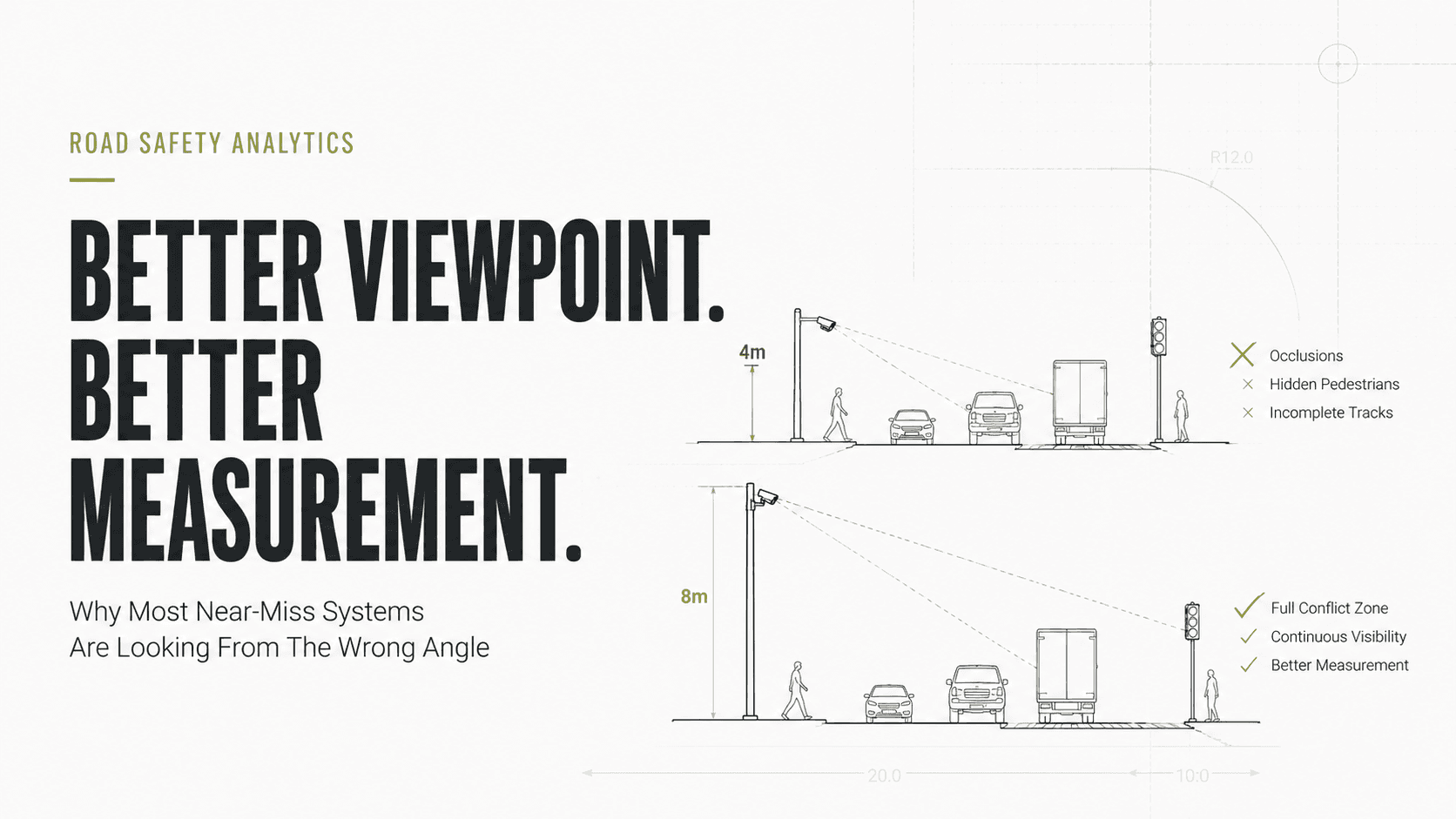
Near-miss detection is often presented as an artificial intelligence problem. In reality, it is first a geometry problem.
When road authorities evaluate near-miss detection systems, the conversation typically revolves around artificial intelligence. Vendors discuss object detection accuracy, neural network performance, edge computing capability and increasingly sophisticated analytics.
These are all important components of a modern road safety platform.
However, there is a more fundamental question that is often overlooked:
Can the system actually see the interaction it is attempting to measure?
Before an AI model can classify a pedestrian, estimate a trajectory, calculate a Post Encroachment Time (PET) value or assess a potential conflict, the interaction must first be observed clearly and continuously.
This is where many systems struggle.
In our experience, the quality of a near-miss detection system is often determined more by deployment geometry than by the AI model itself. A perfectly trained model cannot recover information that was never visible in the first place.
Surveillance and Measurement Are Not The Same Thing
Historically, roadside cameras have been installed for surveillance and operational awareness.
Their purpose was simple:
- Provide visibility to operators
- Record incidents
- Assist investigations
- Support traffic management
For these applications, almost any viewpoint can be useful. If an operator can see what happened, the camera has generally achieved its objective.
Near-miss detection is fundamentally different.
The objective is no longer observation.
The objective is measurement.
To measure safety risk accurately, a system must continuously observe the relationship between multiple road users moving through space. It must understand where they are, how fast they are moving, where they are heading and how their paths interact with one another.
This is a far more demanding task than simply recording video or counting cars.
Key Principle
A surveillance camera asks:
“What happened?”
A near-miss detection system asks:
“How close were road users to colliding, and how severe would the outcome have been?”
The Hidden Challenge: Occlusion
One of the most significant challenges in roadside perception is occlusion.
Intersections are dynamic environments where larger objects regularly obscure smaller ones. Buses block pedestrians. Trucks hide cyclists. Queued vehicles obscure crossing movements. Street furniture creates blind spots.
From a surveillance perspective, these limitations may be acceptable.
From a measurement perspective, they are a serious problem.
A pedestrian disappearing from view for two seconds may not seem important, but those missing seconds can dramatically affect conflict analysis. If the system loses visibility of a road user during a critical interaction, it may no longer be able to accurately determine:
- Speed
- Trajectory
- Conflict location
- PET
- TTC
- Severity
The result is uncertainty.
And uncertainty reduces confidence in the measurement.
Why Height Changes Everything
One of the simplest ways to improve visibility is to change perspective.
As camera elevation increases, the system gains a more complete understanding of the environment and the relationships between road users.
Rather than looking through traffic, the system begins looking over it.
This creates several important advantages.
Improved Visibility
A greater portion of the intersection remains visible throughout the interaction.
Pedestrians remain visible for longer.
Cyclists are less likely to disappear behind vehicles.
Turning movements can be tracked more consistently.
Better Trajectory Reconstruction
Near-miss detection depends heavily on understanding movement.
Higher viewpoints provide clearer observations of:
- Approach paths
- Turning paths
- Crossing movements
- Queue development
- Conflict zones
This allows trajectories to be reconstructed more accurately and consistently.
Improved Conflict Detection
Many conflicts are subtle.
A vehicle slowing slightly.
A cyclist altering direction.
A pedestrian hesitating before crossing.
These interactions are easier to identify when the entire conflict zone remains visible throughout the event.
Greater Measurement Confidence
Road authorities are increasingly relying on near-miss data to support investment decisions.
The obvious question becomes:
How confident are we in the result?
Higher quality observations produce higher confidence measurements.
Why More Resolution Doesn’t Solve The Problem
A common misconception is that poor visibility can be solved by increasing camera resolution.
It cannot.
A 4K camera mounted in a poor location still suffers from the same visibility limitations.
More pixels do not eliminate occlusions.
More pixels do not reveal pedestrians hidden behind trucks.
More pixels do not reconstruct trajectories that were never observed.
This is why deployment geometry should be considered before sensor specifications.
The first question should not be:
How many megapixels does the camera have?
The first question should be:
Can the system consistently observe the interaction we are attempting to measure?
Only after that question is answered should discussions around sensor performance begin.
The Practical Sweet Spot
Every site is different.
Pole heights, road geometry, vegetation, infrastructure and operational requirements all influence deployment decisions.
However, through real-world deployments, one trend has emerged consistently.
As mounting height increases, measurement quality generally improves.
While there is no universal rule, installations between approximately 7 and 10 metres often provide a strong balance between coverage, visibility and spatial accuracy. Less than 5 meters and the perception becomes far too distorted to produce accurate delta and angle of impact measurements to score for severity.
At these heights, systems are typically able to observe:
- Pedestrian crossings
- Turning movements
- Cyclist trajectories
- Queue development
- Vehicle interactions
- Conflict zones
with significantly fewer occlusion issues.
Importantly, the benefit is not simply better imagery.
The benefit is better data.
And road safety decisions ultimately depend on data quality.
What Better Geometry Enables
✓ More complete trajectories
✓ Better PET calculations
✓ Better TTC calculations
✓ More reliable conflict detection
✓ Improved severity assessment
✓ Higher confidence in safety analytics
Less than 5 meters and the perception becomes far too distorted to produce accurate delta and angle of impact measurements to benchmark site to site.
Why This Matters For Road Safety
Road safety agencies around the world are increasingly interested in moving from crash analysis to risk analysis.
That shift depends on measurement.
Metrics such as:
Post Encroachment Time (PET)
Time To Collision (TTC)
Conflict Frequency
Severity Classification
Risk Scoring
all rely on one critical assumption:
The interaction was observed accurately.
If the observation is incomplete, the analysis becomes less reliable.
If the analysis becomes less reliable, confidence in the resulting decisions begins to erode.
The quality of the decision is therefore directly linked to the quality of the observation.
Looking Beyond Artificial Intelligence
Artificial intelligence will continue to improve.
Models will become faster.
Classification accuracy will increase.
Processing hardware will become more capable.
Yet many of the biggest improvements in near-miss detection may come from something far less glamorous than AI.
Better measurement design.
The most sophisticated model in the world cannot compensate for poor visibility.
Before infrastructure can understand risk, it must first be positioned to observe it.
That is why the future of near-miss detection is not simply about smarter algorithms.
It is about smarter observation.
And today, many systems are still looking from the wrong angle.
Key Takeaway
The quality of a near-miss detection system is determined by geometry before it is determined by artificial intelligence.