
Resource Library
Building a Repeatable Framework for Measuring Road Safety Risk
By Simon Maselli
- Evidence Frameworks
- Safety Risk
- Location Intelligence
- Transport Engineering
Road authorities have spent decades refining the way they measure traffic operations.
Traffic volumes, travel times, queue lengths, signal performance and asset condition are all supported by established methodologies, standard datasets and mature engineering processes.
Road safety has traditionally been different.
While crash analysis remains a critical component of safety planning, it presents a fundamental limitation: crashes are relatively rare events. Serious crashes are rarer still. As a result, agencies are often required to make investment decisions using datasets that are both retrospective and statistically sparse.
This challenge has become increasingly important as transport agencies adopt Vision Zero principles and seek to identify safety risks before they result in serious injury or fatalities.
The question is no longer whether risk can be measured.
The question is whether it can be measured consistently.
From Crash Analysis to Risk Analysis
Historically, safety investigations have focused on understanding where crashes occurred and why.
A risk-based approach seeks to answer a different question:
Where is harm most likely to occur next?
Answering this requires visibility into interactions between road users, not just the outcomes of those interactions.
Every collision is preceded by a series of behavioural decisions, movements and conflicts. By measuring these precursors, agencies can begin to understand risk before it appears in crash statistics.
The challenge is creating a framework that allows these interactions to be measured consistently across locations, projects and years.
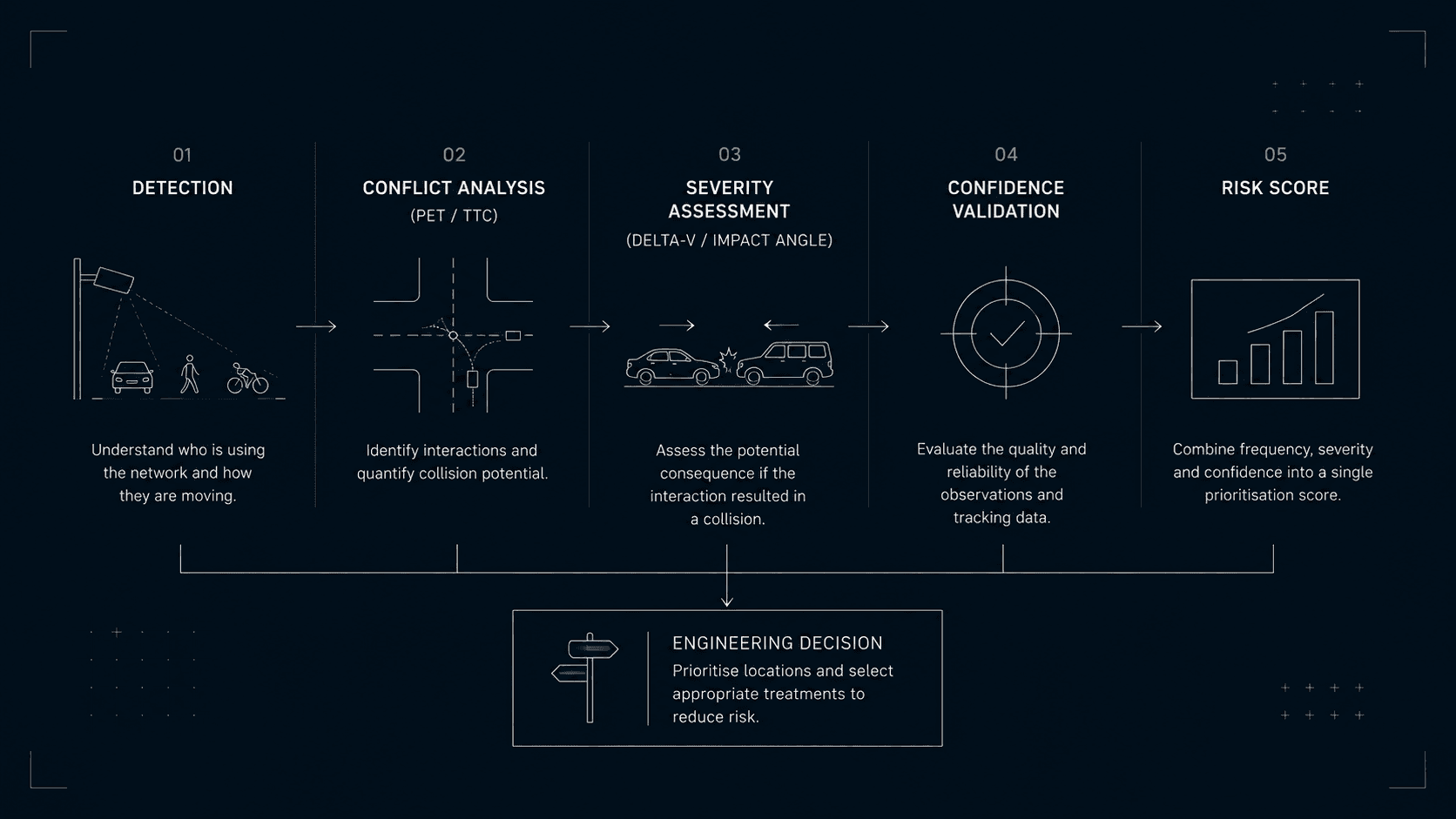
Layer 1: Detection
The foundation of any risk framework is understanding who is using the network and how they are moving through it.
This includes:
- Vehicles
- Heavy vehicles
- Motorcycles
- Pedestrians
- Cyclists
- Mobility users
Detection alone does not measure safety.
However, without accurate detection, meaningful safety analysis is impossible.
This layer establishes exposure, providing context for every subsequent assessment.
Layer 2: Conflict Analysis
Once movements are understood, the next step is identifying interactions between road users.
Conflict analysis focuses on situations where two or more road users occupy trajectories that create collision potential.
Two commonly used indicators include:
Post Encroachment Time (PET)
PET measures the time difference between one road user leaving a conflict area and another entering the same space.
Lower PET values indicate increasingly severe conflicts.
Time To Collision (TTC)
TTC estimates how long two road users would take to collide if they continued along their existing trajectories and speeds.
TTC provides insight into potential collision risk before evasive action occurs.
Together, PET and TTC provide objective measures of interaction quality and allow agencies to identify locations where conflicts occur frequently, even in the absence of crashes.
Layer 3: Severity Assessment
Not all conflicts represent the same level of risk.
A low-speed interaction between two vehicles is fundamentally different from a conflict involving a cyclist and a heavy vehicle.
To move beyond conflict counts, potential consequence must also be considered.
Severity assessment may include:
- Relative speed
- Delta-V estimation
- Impact angle
- Road user vulnerability
- Movement geometry
This layer seeks to answer a critical question:
If this interaction had become a collision, how severe might the outcome have been?
Layer 4: Confidence
Safety decisions require confidence.
False positives, incomplete tracking and uncertain observations can reduce trust in analytical outputs.
A robust framework should therefore consider:
- Detection confidence
- Classification confidence
- Tracking continuity
- Observation quality
Confidence does not replace severity.
It provides context regarding how much trust can be placed in the underlying assessment.
Layer 5: Risk Scoring
The final step is converting large volumes of observations into a format that can support decision making.
Risk scoring combines:
- Conflict frequency
- Conflict severity
- Observation confidence
into a single prioritisation framework.
This enables:
- Site-to-site comparison
- Trend analysis over time
- Funding prioritisation
- Treatment evaluation
- Network-wide risk assessment
Importantly, risk scores are not intended to replace engineering judgement.
They provide a consistent language for discussing risk across different projects and locations.
A Practical Example
Consider two intersections.
The first has recorded several minor crashes over a five-year period.
The second has recorded very few crashes but exhibits frequent low-PET pedestrian conflicts, elevated vehicle speeds and repeated interactions involving vulnerable road users.
Traditional analysis may prioritise the first location.
A risk-based framework may identify the second location as representing a greater future safety concern.
This distinction becomes increasingly important when agencies seek to intervene before serious harm occurs.
The Path Forward
Road safety is unlikely to move away from crash analysis entirely, nor should it.
Crash data remains one of the most important measures available to transport professionals.
However, it is increasingly clear that crash data alone is insufficient for understanding future risk.
The next evolution of road safety assessment will likely involve combining historical outcomes with leading indicators of risk.
Agencies that develop consistent methodologies for measuring conflict, severity and exposure will be better positioned to identify emerging issues, prioritise investment and evaluate interventions before waiting years for crash statistics to mature.
The future of road safety is not replacing crash analysis.
It is augmenting it with measurable risk.